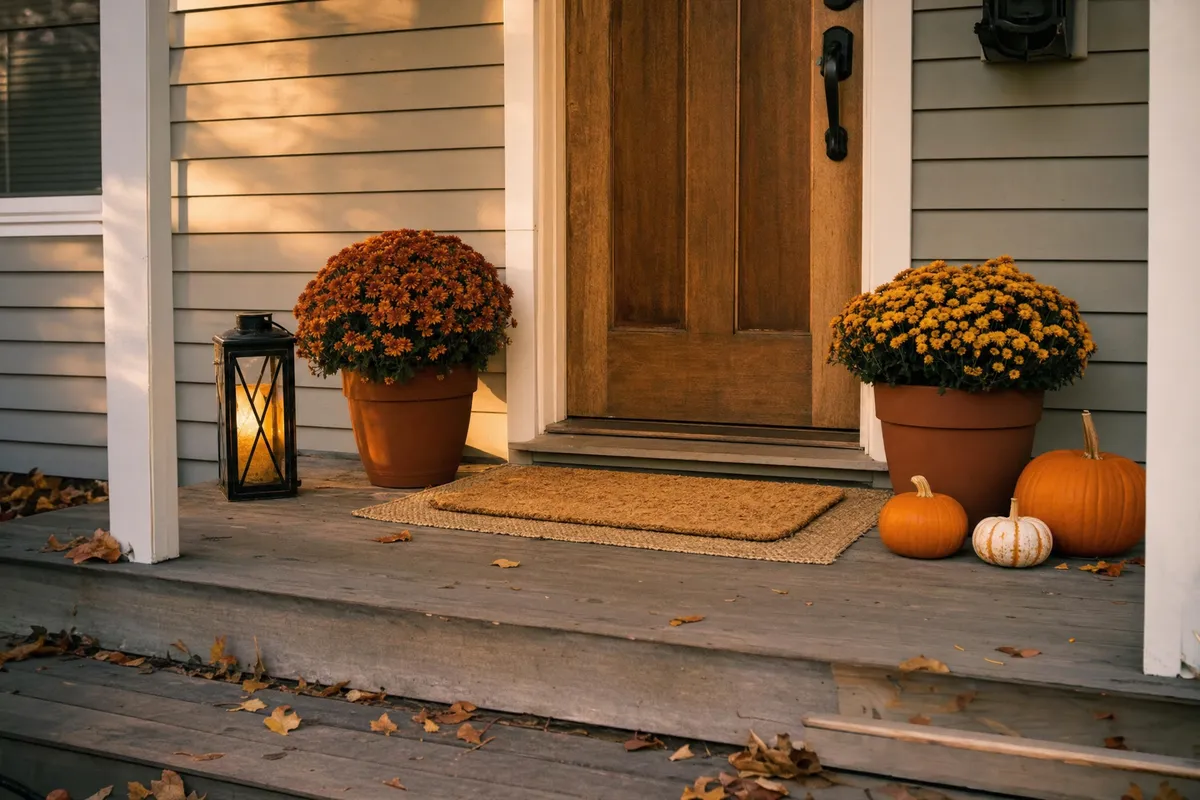
A fall porch that looks expensive is four layers: a doormat combo, mums, a pumpkin cluster, and one light source. Buy those four things right (about $75 total at big-box prices) and you can ignore almost everything else in the seasonal aisle. The list below starts with the four that matter.
The four-layer formula
Before you buy anything, look at photos of porches you like and count what’s actually in them. Almost every one has a rug at the door, plants, pumpkins somewhere, and a light. Four things, with empty space between them. Every idea below feeds one of those layers, so start at the top and stop when it feels done.
1. Layer two doormats
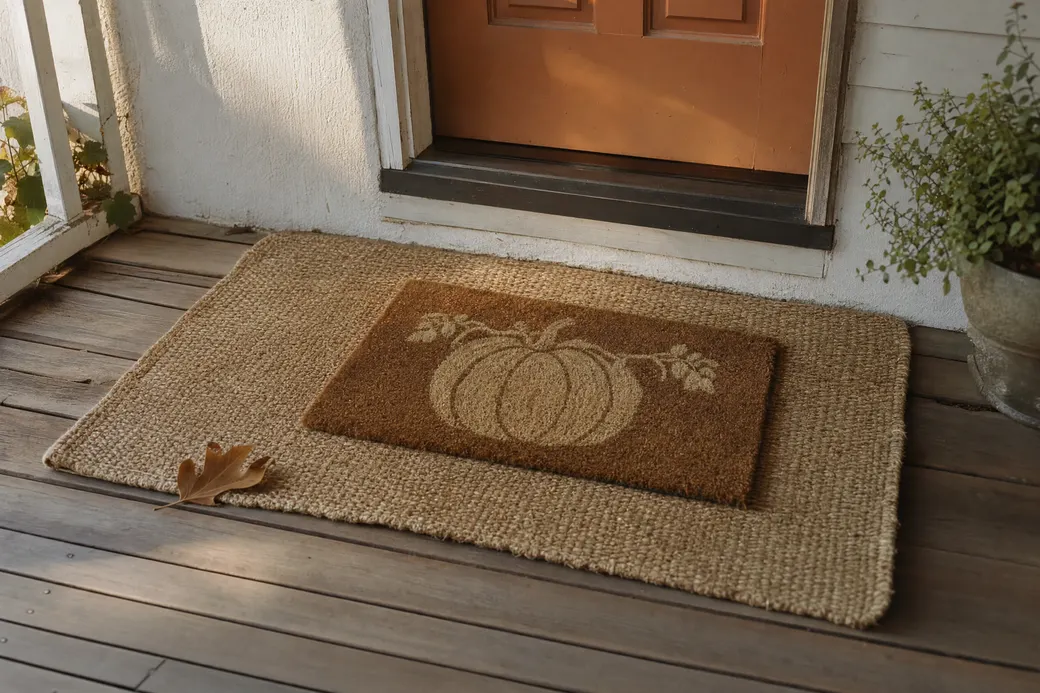
This is the highest-impact $40 on the list. Put a plain 3x5 jute rug flat against the door, then center a smaller fall coir doormat on top of it. The jute frame makes a $15 doormat read like a styled entry instead of a mat someone bought on the way home.
A 3x5 jute layering rug runs $32 to $47 on Amazon (the nuLOOM ones sit right in that range), and no-name versions dip closer to $25. Fall coir doormats at Target and Home Depot are generally under $25, so the combo lands between $40 and $65. Closer to $35 if you hunt. And the jute rug isn’t seasonal. It stays down through Christmas, which cuts the real cost per season in half.
One rule: the top mat should cover no more than about half the rug. If the proportions are close, it just looks like two mats.
2. Stack pumpkins in odd numbers
Three pumpkins, three sizes, one spot. A standard carving pumpkin ran about $5 to $6 last fall (the Farm Bureau tracked $6.21), and Walmart sold 14-pounders for under $4. Add a couple of pie pumpkins at $1.50 to $4 each and the whole stack costs under $15.
Skip the perfectly round ones. Mix a tall skinny pumpkin with a squat wide one.
3. Ring a post with corn stalks
Farm stands and garden centers sell corn stalks for $0.50 to $2 apiece, roughly $5 to $15 for a generous bundle. Tie them to a porch post with twine and hide the twine with a strip of plaid fabric. They show up mid-September and are usually gone by early November, so don’t wait until Halloween week to go looking.
Don’t buy the shipped decor-bundle versions online either. Home Depot’s boxed set of two runs about $25 for less corn than your local farm sells for $10.
4. Do the mum math before the store does it for you
It’s easy to spend $80 on mums without noticing, so here’s the math. A standard 3-quart mum runs $4 to $7 at Home Depot, Lowe’s, Walmart, Aldi, or Trader Joe’s. Jumbo pots run $15 to $25 (Walmart’s 16-inch is $19.97). Two jumbos flanking a door cost $40. Four standards clustered in pairs cost about $24 and read nearly as full once they open up.
The better play is timing. Mums hit stores from mid-August through mid-September, and Labor Day weekend is reliably the promo window: Lowe’s ran 3-quart mums at two for $8 in 2025, and Home Depot dropped theirs to $2.50. Buy plants that are still in tight bud, mostly green with just a hint of color. Clemson’s horticulture extension says bud-stage plants hold their display far longer, which is how you get four to six weeks of bloom instead of catching the tail end.
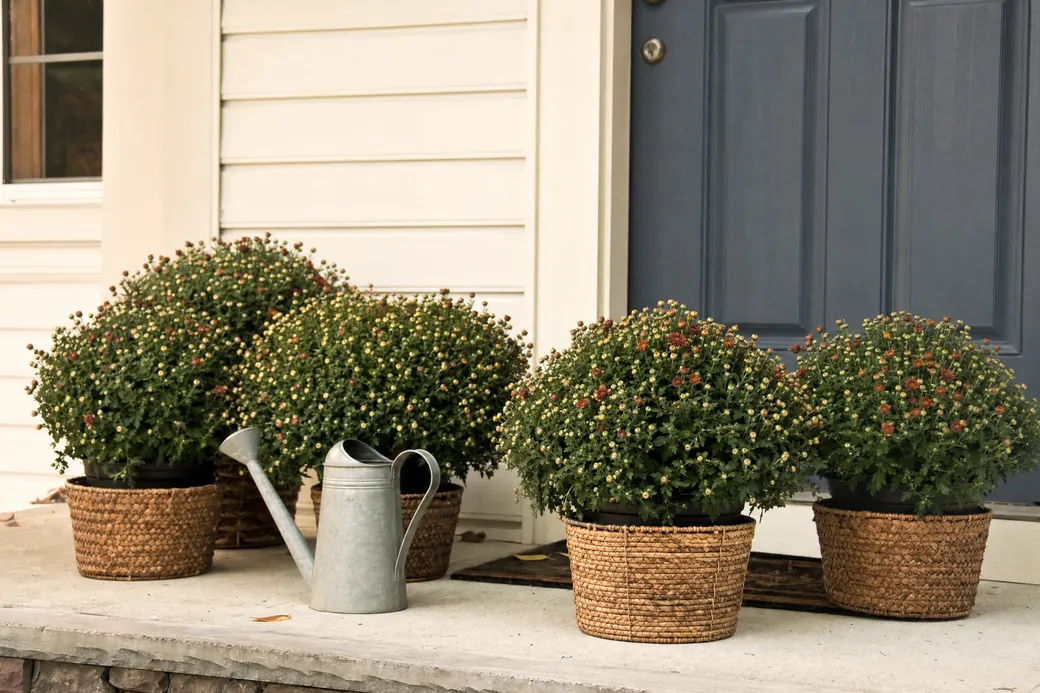
Keeping them alive is unglamorous. Six hours of direct sun minimum, check the soil every day, water until it runs out the drainage holes whenever the top feels dry. A mum that wilts hard once never fully bounces back. I’d rather have two well-watered standards than four crispy jumbos.
5. Stack thrifted crates into a side table
Two wooden crates from Facebook Marketplace or Goodwill, stacked, holds a lantern or a small pumpkin. Under $10 most weeks, free if you’re patient.
6. Drape a plaid throw where it can be seen
Over a bench arm or chair back, folded loosely. Any $10 to $15 throw works because nobody inspects the fabric from the sidewalk.
7. Upgrade dollar-store pumpkins instead of buying foam ones
Dollar Tree’s foam pumpkins look like foam. Painted matte cream or sage with a real twig hot-glued over the plastic stem, they pass from six feet away. Fifteen minutes of work and about $5 for a set of three.
8. One sign, maximum
Porch signs multiply. A “hello pumpkin” leaner next to a “welcome fall” flag next to a chalkboard is a gift shop, not a porch. Pick one, or skip the category.
9. Cluster lanterns instead of scattering them
Group three lanterns at different heights: floor, crate, step. Scattered singles disappear; the tight group reads as a display. Decent solar or battery outdoor lanterns run $10 to $30 at Walmart, Target, and Amazon (Walmart’s Better Homes & Gardens solar pendant was $15 this season, and two-packs bring the per-unit price down). Solar means no cords across the doormat and they come on by themselves at dusk.
If you already own mismatched lanterns, spray paint unifies them in an afternoon.
10. Swap pillow covers, not pillows
If you have porch seating, $8 to $12 covers over the inserts you already own beat $25 seasonal pillows. The covers store flat in January in less space than a shoebox.
11. Re-ribbon the wreath you already own
A plain grapevine or eucalyptus wreath takes fall with a $5 wired ribbon and nothing else. New wreaths cost $30 and up for a look you can borrow for five.
12. Use a hay bale as a riser
Around $10 at the same farm stands selling corn stalks. It lifts your pumpkin stack to porch-rail height where people can actually see it from the street. Skip it if your porch gets rained on; soggy hay smells exactly like you’d expect.
13. Fill a bucket with what’s already outside
A galvanized bucket or basket of pinecones, apples, or decent-looking sticks costs almost nothing. Real apples on a covered porch last a couple of weeks and get eaten by someone either way.
14. Replant window boxes with cool-season survivors
Summer annuals are done by September anyway. Ornamental kale and pansies handle frost, cost a few dollars a plant, and hold the look into November after everything else on this list is compost.
15. Put one battery candle in the window
Set it on the windowsill inside, facing out, on a timer. A $6 flickering candle does more for the whole front of the house at 7pm than another daytime decoration would.
What to skip
No inflatables. Faux garland wrapped around railings comes loose in the first real wind and hangs there until you deal with it; save garland for the protected mantel indoors. Scented anything outdoors is money spent perfuming the neighborhood. And skip the pre-styled “porch bundle” kits online, which charge $25 to $30 for corn stalks and a pumpkin you can assemble locally for half.
When to put it all out
Earlier than feels natural. Fall inventory lands in stores in August, Labor Day is the price bottom for mums, and the shelves flip fast: HomeGoods has set Christmas out on October 1 for years now, and retail trackers put a third of Christmas decor purchases in October and November. Wait until mid-October to buy fall decor and you’re shopping the leftovers. Decorate whenever you like; just buy by late September.
Fall porch FAQ
What’s the earliest I can decorate without it looking premature? Pumpkins and mums pass from Labor Day on. If it still feels summery where you live, start with the doormat layer and window boxes and add the rest when nights cool down.
What’s a realistic total budget? About $75 gets the four core layers at regular prices: $40 doormat combo, $12 to $15 in mums bought on promo, $12 in pumpkins, $15 lantern. Half of that if you thrift the rug and catch the Labor Day mum deals.
Do real or faux pumpkins hold up better outside? Real, for one season. They handle weather better than cheap foam and cost less than good faux. Uncarved pumpkins on a covered porch routinely last eight weeks. Buy good faux only if you’ll reuse it three seasons or more.
What about a shaded, north-facing porch? Mums won’t keep blooming without six hours of sun. Use the shade-tolerant swaps: ornamental kale and pansies for the growing layer, then lean harder on lanterns and pumpkins, which don’t care about light at all.